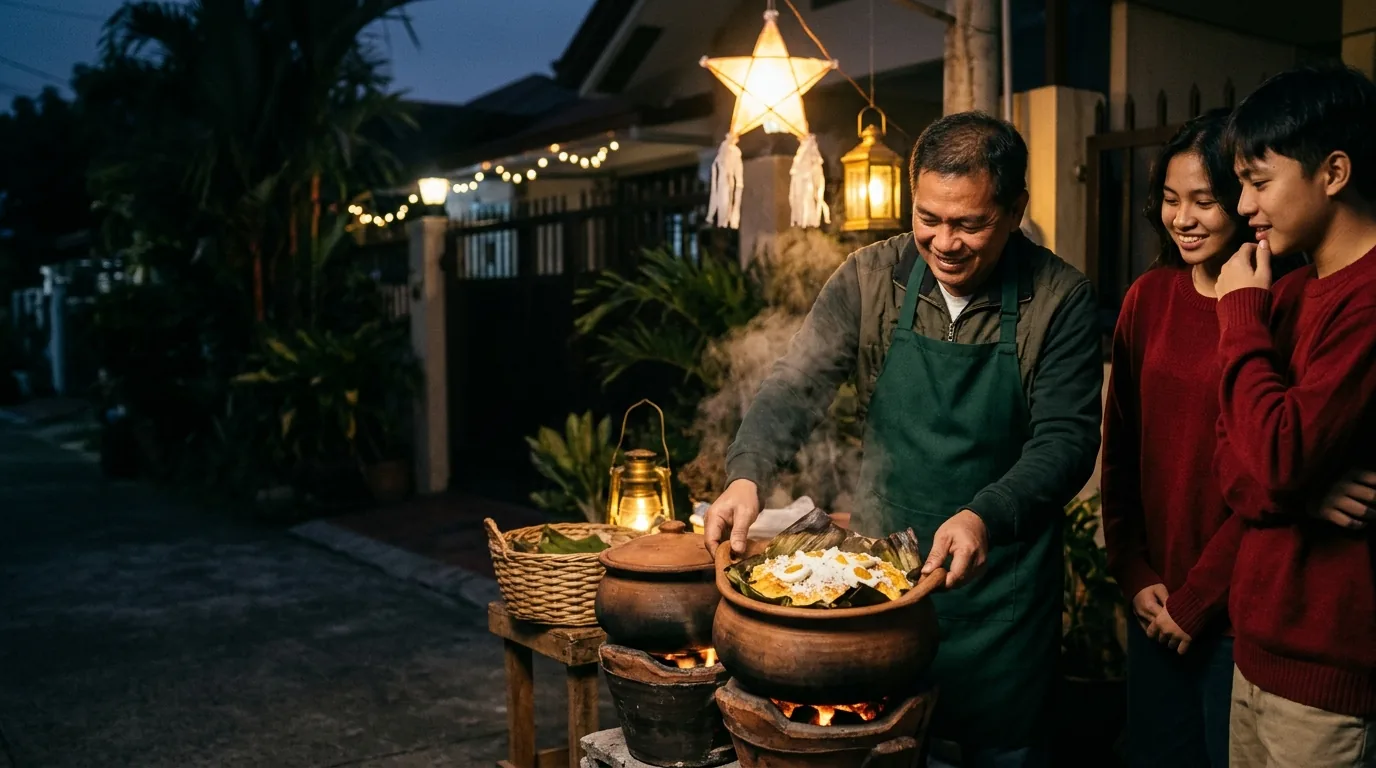
Philippines · Sold outside churches after Simbang Gabi dawn Masses from December 16 to December 24 across the Philippines
Bibingka (Baked Coconut Rice Cake)
Warm, lightly charred rice-flour cakes topped with salted egg, cheese, and grated coconut
45 min
6 individual cakes
Easy
Dessert & sweet
Culinary & Cultural Story
Bibingka is traditionally cooked in clay pots lined with wilted banana leaves, set over charcoal embers below and topped with glowing coals on a sheet-metal lid above. During Simbang Gabi, the nine-day novena of dawn Masses leading up to Christmas Eve, street stalls fill church courtyards with the aroma of toasted banana leaf and coconut milk. In a home oven, a short broil at the end recreates the lightly browned top.
Preparation
Prepare the Leaves and Batter
- 5 min
Preheat the oven to 375°F (190°C). Briefly pass each banana leaf square over a gas flame or warm skillet for a few seconds until pliable and glossy, then press one square into each of six 6-inch (15 cm) round cake pans or large ramekins.
Kitchen tip: Warming the banana leaf prevents it from cracking when folded into the pan and releases its aroma.
- 2 min
Whisk the rice flour, sugar, baking powder, and salt together in a large bowl.
- 2 min
In a separate bowl, beat the eggs lightly, then whisk in the coconut milk, whole milk, and melted butter.
- 2 min
Pour the wet ingredients into the dry ingredients and whisk until completely smooth with no dry pockets.
Bake and Finish
- 2 min
Divide the batter evenly among the leaf-lined pans, filling each about two-thirds full.
- 17 min
Bake for 15 minutes until the edges begin to set. Pull the rack out briefly and arrange slices of salted egg and grated cheese over the top of each cake.
- 8 min
Return to the oven and bake until a toothpick inserted in the center comes out clean, 6 to 8 minutes more. Switch the oven to broil for 1 to 2 minutes to lightly brown the tops.
Kitchen tip: Watch closely under the broiler so the banana leaf edges do not scorch.
- 2 min
Brush the warm tops with softened butter, scatter with grated coconut, and serve immediately.
Make-ahead notes
Bibingka is most tender when eaten warm on the day it is baked. Leftovers keep covered at room temperature for 1 day or refrigerated for 3 days; rewarm in a 325°F (165°C) oven for 8 minutes.
Serving notes
Serve warm straight from the banana leaf alongside hot salabat (ginger tea) or tsokolate (thick hot chocolate).
Regional variations
- Bibingka Galapong: Traditional versions soak glutinous and non-glutinous rice overnight and grind them with coconut milk into a fermented batter (galapong) for a tangier, moister crumb.
- Single 9-Inch Cake: Line one 9-inch (23 cm) round cake pan with overlapping banana leaves and bake for 28 to 35 minutes total, adding the toppings after 20 minutes.
Verified sources
- Simbang Gabi and Christmas Food Traditions in the Philippines — National Commission for Culture and the Arts (Philippines)
- Bibingka — Encyclopaedia Britannica